Banco de Moçambique’s latest inclusion data shows wallets multiplying faster than the things people do with them.
Mozambique now has more electronic-money accounts than adults: 1,093 per 1,000 in 2024, up 18% from 926, according to Banco de Moçambique’s Relatório de Inclusão Financeira 2025. The same report shows what those accounts are mostly used for. Withdrawals took 41% of wallet transaction volume, up 9 percentage points, and deposits fell to 11%.
That pairing is the story of digital payments in 2025. Account counts measure registration, and one person can hold several wallets. The economic weight sits in payments, which reached 29% of volume, and in the merchant and agent networks that let a wallet balance be spent without turning back into notes.
Registration has outrun use
The headline ratio counts wallets, not people, and the mix of transactions shows the balance being drawn straight back out.
The central bank itself flags that a ratio above 1,000 means some holders carry more than one account. Women’s ownership rose 58%, from 585 to 924 accounts per 1,000 adults, against 22% for men, who moved from 1,011 to 1,236. The gap is narrowing quickly, and Cidade de Maputo leads at 1,977 accounts per 1,000 adults.
The lowest ownership sits in Zambézia, Tete and Cabo Delgado. Set that beside the report’s finding that Niassa, Zambézia and Cabo Delgado have the thinnest coverage of access points, and the pattern is plain: wallets follow agents, and agents follow economic activity.
Mechanism: how a wallet becomes a payment rail
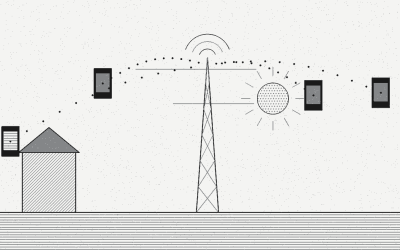
Value moves through a chain of float, agents and interoperable switching, and each link decides whether money stays digital.
A wallet is a claim on trust-account balances held at a bank. Customers load it by handing cash to an agent, who holds electronic float and earns commission on both directions. Vodacom’s M-Pesa director general, Sérgio Gomes, said in April 2025 that the platform had more than 11 million subscribers, over six million of them active every month, and 120,000 agents. Those are the operator’s own figures.
Interoperability made the rail national. Since July 2022, M-Pesa, mKesh and e-Mola settle through the switch of the Sociedade Interbancária de Moçambique (SIMO), so a merchant can accept one wallet and receive money from all three. The report credits that interconnection, extended to banks and microbanks, for the expansion of e-money.
Cards, terminals and the shifting channel mix
Banking channels are growing too, but not evenly.
Access points rose 37% in 2024 to 356,785, driven by non-bank agents and point-of-sale terminals. Among bank channels, ATM transactions grew to 39% of volume and POS to 24%, while mobile banking slipped 7 percentage points to 27%. The bank-based customer is moving toward the machine and the till, and the phone is carrying the informal, low-balance economy.
Bank accounts show the other side: 330 per 1,000 adults in 2024, up from 299. Credit to the economy fell to 20% of GDP and deposits rose to 49%, with non-performing loans at 9.4%. Money is entering formal channels faster than it is being lent out of them, which is why wallet float and deposit balances matter to banks.
What to do with the numbers
Measure a payment business by repeat payments per active user, not by accounts opened.
A retailer, utility or school should price acceptance from the 29% payments share and the 11% deposit share: customers reach a wallet mainly to withdraw or pay, so a merchant that accepts wallet payments at the till captures money before it is cashed out. TotalEnergies signed a memorandum with Vodacom in April 2025 to accept M-Pesa for digital services, a move aimed at customer retention and safer forecourts.
For a lender or insurer, the lead is the 11% deposit share: paying money into wallets is the weakest flow, so savings products need a reason to keep balances digital. Vodacom’s 945 billion meticais of annual M-Pesa flows, which its chief Sérgio Gomes told the press in May 2024 was largely informal activity, show the volume is there. Request merchant-level settlement data from your acquirer or wallet provider, split by payment, transfer and cash-out, and set next year’s acceptance targets from that split.
Sources
- Banco de Moçambique. “Relatório de Inclusão Financeira 2025”. October 2025. https://www.bancomoc.mz/media/nvelycjp/relatorio-inclusao-finaceira-maio031025pt-f.pdf
- AIM – Agência de Informação de Moçambique. “Vodacom e TotalEnergies assinam memorando para aceitação de pagamento de serviços digitais via M-Pesa”. 1 April 2025. https://aimnews.org/2025/04/01/vodacom-e-totalenergies-assinam-memorando-para-aceitacao-de-pagamento-de-servicos-digitais-via-m-pesa/
- Banco de Moçambique. “Interoperability of mobile money operators in effect: mKesh, M-Pesa and e-Mola”. 11 July 2022. https://www.bancomoc.mz/media/edrlrwxe/communiqu%C3%A9-interoperability-of-mobile-money-operators-in-effect-mkesh-m-pesa-and-e-mola.pdf
- Club of Mozambique. “Mozambique: M-Pesa hits $15 billion in transactions”. 29 May 2024. https://clubofmozambique.com/news/mozambique-m-pesa-hits-15-billion-in-transactions-258958/
- Banco de Moçambique. “Estatísticas – Domínios e indicadores estatísticos”. https://bancomoc.mz/pt/areas-de-actuacao/estatisticas/dominios-e-indicadores-estatisticos/