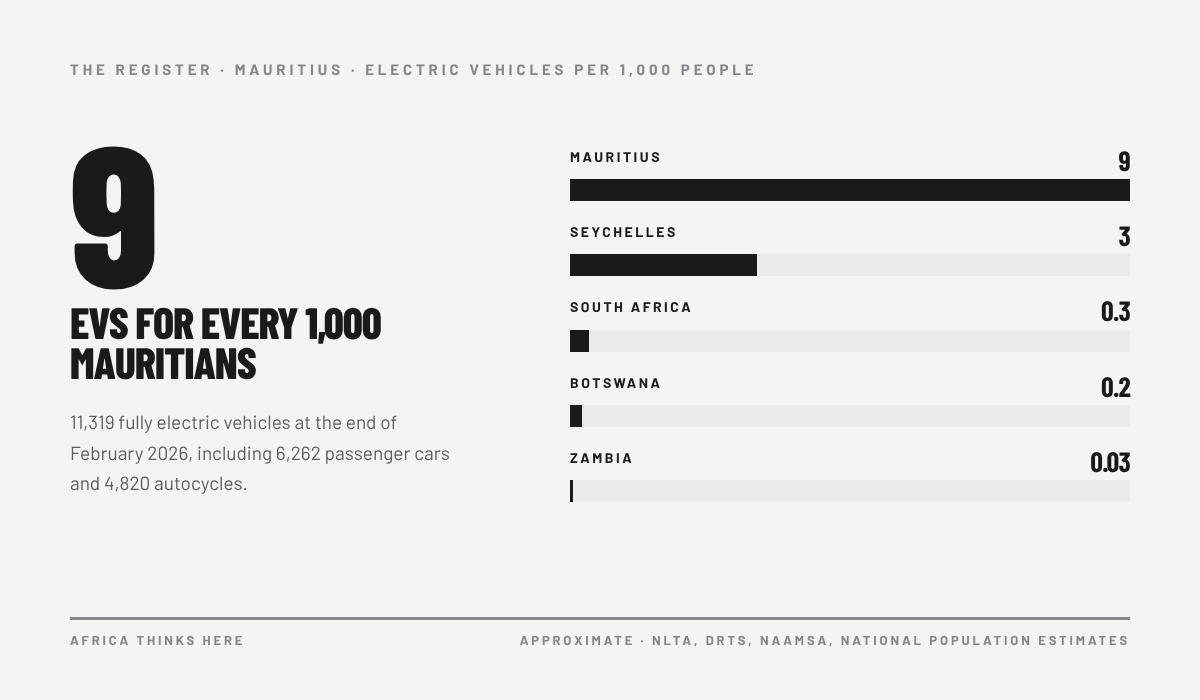
Mauritius has about nine electric vehicles for every 1,000 people. That is roughly thirty times South Africa’s rate and three times the Seychelles’. On the measure that tells a charging operator where demand will be densest, the island is the leading electric vehicle market in Southern Africa.
The ground. The NLTA recorded 11,319 fully electric vehicles at the end of February 2026:
| Vehicle type | Number |
|---|---|
| Passenger cars | 6,262 |
| Autocycles | 4,820 |
| Goods vehicles | 88 |
| Double-cab pick-ups | 75 |
| Buses | 56 |
| Motorcycles | 15 |
| Mixed-use | 3 |
By July 2026 the electric bus fleet had reached 106, according to reporting carried by allAfrica. The NLTA has also registered 65,321 hybrid vehicles between 2010 and August 2026. All of these vehicles sit within a national fleet of 746,961.
The comparison makes the point. South Africa’s 19,400 plug-in vehicles across a population above 60 million give about 0.3 per 1,000. Botswana’s nearly 500 give about 0.2. Zambia’s 525 registered electric vehicles give about 0.03. Even the Seychelles, another island with short distances, sits at about 3 per 1,000.
The mechanism. Three things make an island the natural first market. Distances are short, so range anxiety – the main reason buyers hesitate – largely disappears. Fuel is imported at a premium, so the running-cost gap between petrol and electricity is wider than on the mainland. And the state controls the full vehicle-import pipeline, so a change in duty or registration fees reaches every buyer at once. Mauritius has used that last lever: its hybrid count shows a market that was steered towards electrification over fifteen years, not one that arrived at it suddenly.
The autocycle figure is the detail most coverage misses. More than four in ten of the island’s electric vehicles are light two-wheelers. They charge from ordinary sockets, cost a fraction of a car and serve the short urban trips that make up most of daily movement. The island has electrified the bottom of the market first, which is the opposite of the mainland, where adoption is led by premium cars.
The consequence. For a business planning Southern African electric mobility, Mauritius is the test market. It shows what charging demand looks like when per-head adoption is thirty times the regional norm. Home and workplace charging carry most of the load, and public infrastructure is used for top-ups, fleets and buses rather than long journeys. Utilisation patterns, tariff structures and fleet contracts proven in Mauritius are the playbook for Gaborone, Windhoek and Lusaka as their numbers rise.
The bus fleet matters most for operators. Electric buses charge at depots on fixed schedules, giving an operator predictable, high-volume demand from a single contract – the opposite of the uncertain public charger.
The decisive close. Any operator entering Southern Africa should study Mauritius before it builds anywhere else, and should aim first for fleet and depot charging, where the demand is contracted rather than hoped for. The island has already shown that electrification starts with the vehicles that move most and travel least.
Sources
- Mega Motors – NLTA: 11,319 electric vehicles on the roads
- allAfrica – Mauritius electric bus fleet reaches 106
- NLTA – Registration of hybrid vehicles 2010 to August 2026
- allAfrica – Mauritius vehicle fleet
- CNBC Africa – South Africa’s EV sales 2026
- Africa News Analysis – Botswana’s EV ambitions
- Zambian Observer – Zambia only has 525 electric vehicles
- SBC – Electric cars in Seychelles