Banco de Moçambique’s own series show the cash cushion of May disappearing and the interbank market stepping in.
On 1 June 2026 Mozambique’s banks borrowed MT8.7bn overnight from Banco de Moçambique’s permanent lending facility at 12.25%, three points above the 9.25% policy rate. Five weeks earlier the same banks had parked as much as MT12.9bn a day at the central bank’s deposit window. The cash cushion of May was gone within a weekend, and June was spent rebuilding it.
The path is visible in two daily series the central bank publishes. They show a policy rate that never moved and a liquidity position that moved a great deal, which is what a treasurer needs to understand about the month.
The two windows swapped places
Banks used the deposit window in May and the lending window in June.
The permanent deposit facility pays 6.25% and the permanent lending facility charges 12.25%. In May, only the deposit side was used: balances ran from MT2.6bn to MT12.9bn a session, peaking on 25 May, and the lending facility was not touched in any May session. Then the position turned. On 1 June the deposit balance was MT2.3bn and the lending balance MT8.7bn.
The lending facility was used in all 21 June sessions. Drawings eased through the month: MT9.15bn on 2 June, MT3.0bn on 10 June, MT1.4bn on 17 June, a low of MT0.3bn on 23 June, and MT3.2bn on the last session, 30 June. Deposits moved the other way, from MT2.3bn on 1 June to a peak of MT9.14bn on 15 June and MT4.9bn on 30 June.
Bank reserve balances in the July monthly statistical summary came to MT302.9bn at the end of June, against MT308.9bn at the end of May and MT236.6bn at the end of April. Reserves fell about MT6bn over June, small against the stock but large against the daily window balances.
How a corridor three points either side holds a rate
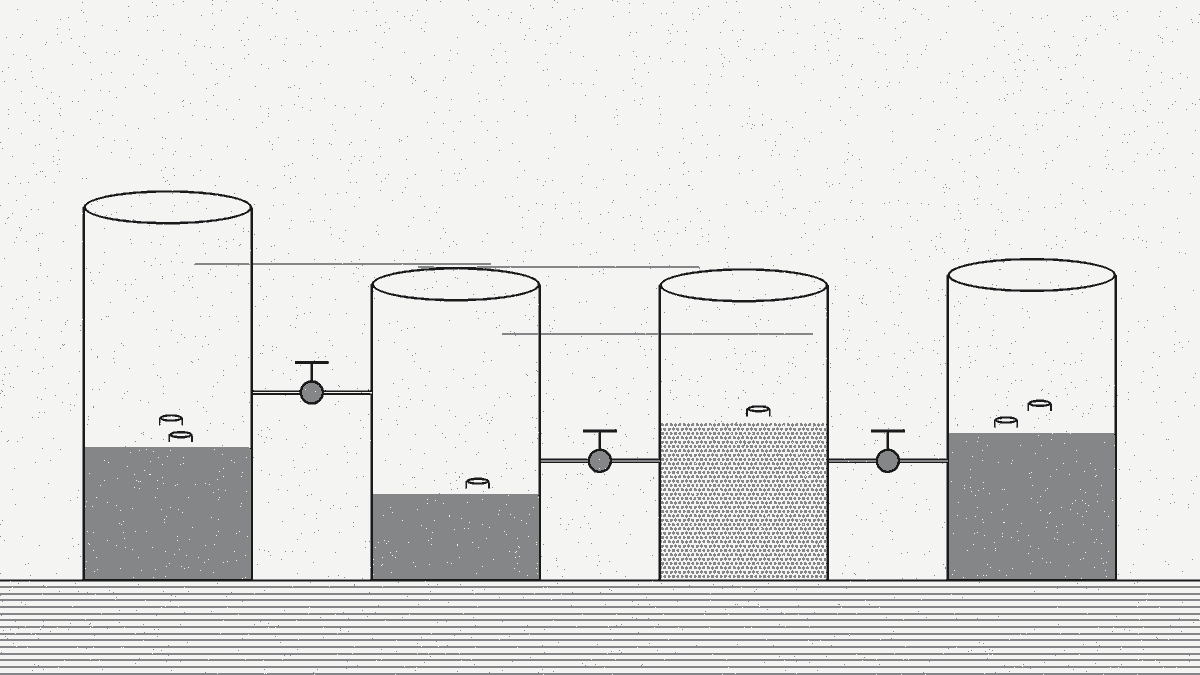
Two fixed windows bracket the market; interbank trades settle between them.
A bank that ends the day short has three choices: borrow from a long bank, borrow against Treasury paper through repo, or go to the lending window at 12.25%. A bank that ends long can lend to a peer or take 6.25% on deposit. Because both windows are fixed and public, trades settle near the middle.
June shows the middle holding. The central bank’s interbank series records 19 liquidity swaps worth MT8.15bn and 39 interbank repo deals worth MT19.98bn, every one of them at a weighted rate of 9.25%. In May there were 13 swaps worth MT6.91bn and 12 repo deals worth MT4.35bn, also all at 9.25%. Volume rose; the price did not.
Repo maturities lengthened as well. Seven-day deals appeared on 3 June (MT1.45bn in total), 10 June (MT1.3bn) and 24 June (MT1.3bn), and the largest single overnight repo, MT2.49bn, came on 17 June. Banks bought funding by the week rather than renewing it by the night.
What the policy stance really was
A held rate and a tighter cash position are two different instruments.
On 26 May the Monetary Policy Committee left the MIMO rate unchanged, kept the facility rates at 12.25% and 6.25%, and held reserve requirements at 39% on domestic-currency liabilities, AIM reported. The headline rate did not change in June.
What changed was the quantity of cash behind it. With reserves at 39% of liabilities, a bank’s daily position is a small gap between a very large required balance and what it actually holds. A few billion meticais moving between the Treasury account, note circulation and reserve accounts is enough to push the whole system from the deposit window to the lending window. Currency in circulation, for instance, rose from MT88.3bn at the end of May to MT91.7bn at the end of June in the same summary.
What a treasurer does with this
Fund by the week, and price the window you might need.
The first lesson is cost. A bank drawing MT8.7bn at 12.25% instead of 9.25% pays about MT0.7m extra for each overnight day, and a corporate with an overdraft priced off the prime rate sees that pressure arrive in its own quote. The second is timing: the month-end and the first sessions of June carried the stress, and mid-June the relief.
Treasurers should agree term repo lines with two or three counterparties before the month-end, keep Treasury bills eligible as collateral, and read the central bank’s daily window balances as an early signal. When the lending facility is used every day, the policy rate is the floor of the funding conversation, not the price. The system is not short of cash overall at MT302.9bn of reserves; it is short on particular days, and banks that plan for those days borrow at 9.25%.
Sources
- Banco de Moçambique. “Série Facilidades Permanentes”. https://www.bancomoc.mz/media/04zojueo/s%C3%A9rie-facilidades-permanentes.xlsx
- Banco de Moçambique. “Série Operações Interbancárias”. https://www.bancomoc.mz/media/pskm0jkg/s%C3%A9rie-opera%C3%A7%C3%B5es-interbanc%C3%A1rias.xlsx
- Banco de Moçambique. “Resumo Mensal de Informação Estatística, Julho 2026”. July 2026. https://www.bancomoc.mz/media/ecnnb2u2/resumo-mensal-de-informa%C3%A7%C3%A3o-estat%C3%ADstica-julho_2026.pdf
- Agência de Informação de Moçambique (AIM). “Banco de Moçambique mantém taxa MIMO em 9,25 por cento”. 26 May 2026. https://aimnews.org/2026/05/26/banco-de-mocambique-mantem-taxa-mimo-em-925-por-cento/
- Banco de Moçambique. “Quadro de Política Monetária”. https://bancomoc.mz/pt/areas-de-actuacao/politica-monetaria/quadro-de-politica-monetaria/