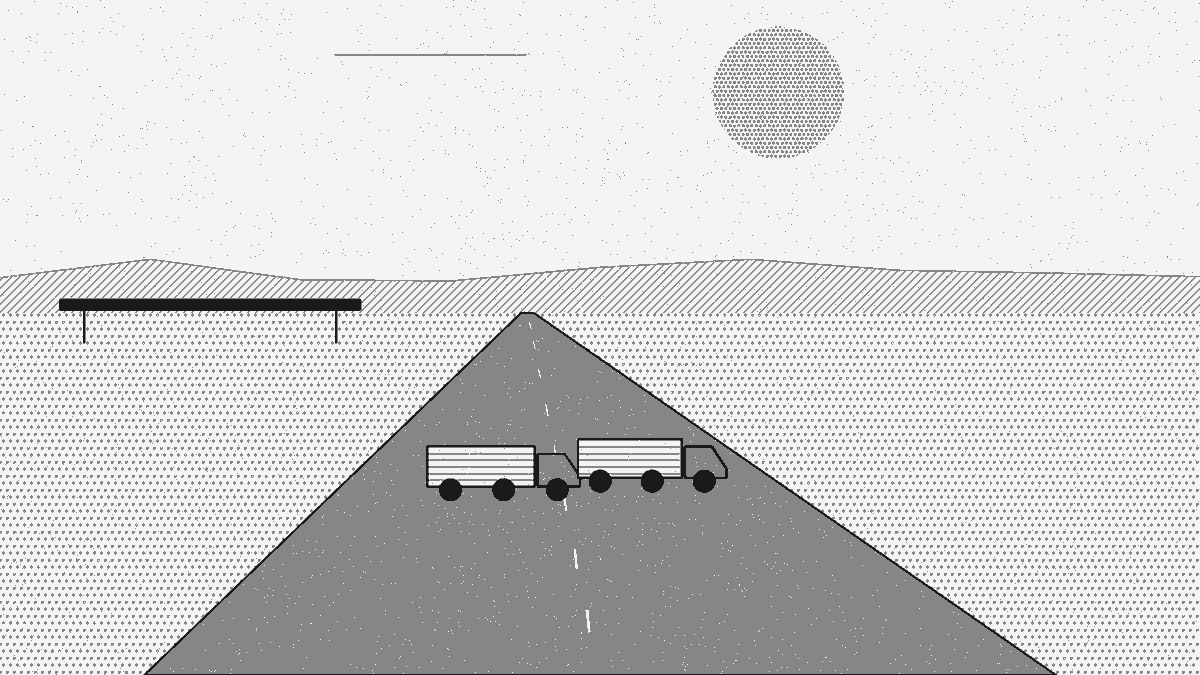
The buildings arrive first; the Beira Corridor’s two-to-three-day truck queues only shrink if both governments change how they inspect.
Construction of the Machipanda one-stop border post in Manica province is scheduled to begin in October 2026, with an investment reported at US$37.2m. Mozambique’s Beira Corridor, which carries goods between the port of Beira and Zimbabwe, runs through this single crossing, and officials quoted by Diário Económico say more than 2,000 trucks pass it daily.
As of late September the project is contracted, not built. The concession has been awarded, the project was presented in Manica on 17 August, and the works are expected to run to 2029. What the border looks like on the day of handover depends on decisions that are not in the civil-works contract.
What has been committed
A concession to a Chinese-backed consortium, a start date, and a completion target roughly 30 months out.
The Club of Mozambique report on the Manica presentation names the consortium partners as Union Energy and Zhongmei Engineering, with construction from October and handover in 2029. Other Mozambican press names the partners as Union Portlink Capital and Zhongmei Engineering Group, and the two descriptions have not been reconciled in the material reviewed here.
The scope, as Diário Económico reports it, includes unified inspection facilities, three new bridges over the Machipanda river, a staff residential area, a 35,000 square metre multimodal cargo terminal and an 18,500 square metre tourist border zone sized for 3,000 passengers a day. The same report gives the concession as 30 years, while Carta de Moçambique, citing the government announcement, gives 25 years. Anyone pricing the asset should obtain the concession contract rather than choose between press versions.
Mechanism: who pays and who earns
The consortium builds with private money, recovers it through operating the facility, and the State holds a minority stake funded by the Road Fund.
Per Carta de Moçambique, the State takes a 15 per cent equity stake, covered by the Road Fund at no cost to the budget, and Manica entrepreneurs are offered 10 per cent. Carta also reports about 700 jobs, 500 in construction and 200 in operation. Carta gives the investment as over US$30m, so the US$37.2m figure should be read as the reported project value, not an audited capital budget.
A concession of this kind earns from fees on services the facility provides: cargo handling, parking, storage, passenger processing. Revenue therefore rises with throughput and falls with delay, which gives the operator an incentive to shorten queues. It does not give the operator control over what customs, immigration and phytosanitary officers on either side decide to inspect.
Consequence: the Road Fund point to watch
The funding vehicle behind the State’s 15 per cent was dissolved in July, so the equity line needs a new owner on paper.
The Roads Fund was extinguished by Decreto 39/2026, with its assets integrated into the Administração Nacional de Estradas. Press reports of the Machipanda equity were written with the fund in mind. Before the first concrete is poured, shareholders and lenders will want to know which institution holds the State’s 15 per cent and on what documents.
For haulers the arithmetic is simple. Officials describe waits of two to three days at present. If the new facility cuts a crossing to hours, a truck on the Beira to Harare run regains days a month, and the saving shows up in transit insurance, driver cost and cargo-in-transit financing. None of that arrives before 2029, so interim congestion management matters as much as the new terminal.
What to watch on the start date
Three signals separate a border project from a building project.
First, whether Zimbabwean officials attend and whether a bilateral agreement on joint inspection is signed or referenced, since one-stop operation needs both States to share premises and procedures. Second, the published hours of operation and the staffing plan for the new terminal. Third, the contractor’s local-content commitments: District Administrator Paulo Quembo asked the consortia on 17 August to involve local businesses and young people.
Transporters and clearing agents on the Beira Corridor should ask their associations to table processing-time targets now, in writing, while the concession terms are still being finalised, and should track the border’s daily truck-wait measurements against those targets from the first day of operation.
Sources
- Club of Mozambique. “Mozambique: Machipanda one-stop border post project presented in Manica”. 17 August 2026. https://clubofmozambique.com/news/mozambique-machipanda-one-stop-border-post-project-presented-in-manica/
- Agência de Informação de Moçambique (AIM). “Modernization of Machipanda border budgeted at 37.2 million dollars”. 17 August 2026. https://aimnews.org/2026/08/17/modernization-of-machipanda-border-budgeted-at-37-2-million-dollars/
- Diário Económico. “Manica: obras para modernizar fronteira de Machipanda arrancam em Outubro”. 29 July 2026. https://www.diarioeconomico.co.mz/2026/07/29/negocios/infra-estruturas/manica-obras-para-modernizar-fronteira-de-machipanda-arrancam-em-outubro/
- Carta de Moçambique. “Governo concessiona a modernização e expansão da fronteira de Machipanda a consórcio chinês”. 2026. https://cartamz.com/economia-e-negocios/52442/governo-concessiona-a-modernizacao-e-expansao-da-fronteira-de-machipanda-a-consorcio-chines/